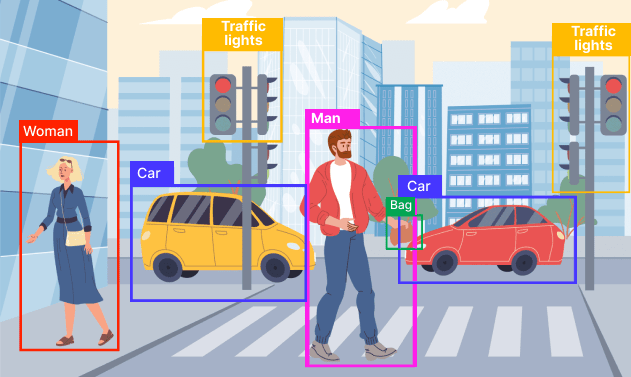
Object detection, a subset of computer vision and machine learning, involves identifying and locating objects within an image or video stream. AI has profoundly transformed this field, making object detection more accurate, efficient, and versatile. This transformation has led to a plethora of applications across various industries. Here’s a detailed exploration of how AI has revolutionized object detection, including its key use cases and applications.
1. Advancements in Object Detection Technology
Object detection has evolved significantly due to advancements in AI. Traditionally, object detection was performed using hand-crafted features and traditional machine learning algorithms. However, modern techniques primarily rely on deep learning and neural networks, particularly convolutional neural networks (CNNs). CNNs have revolutionized the field by enabling automatic feature extraction and learning complex patterns, leading to more accurate and robust object detection models.
Key Technologies:
- Convolutional Neural Networks (CNNs): CNNs are designed to automatically and adaptively learn spatial hierarchies of features from input images. They have become the backbone of modern object detection.
- Region-Based CNNs (R-CNNs): R-CNNs improved object detection by generating region proposals and classifying each region. However, they were computationally expensive.
- Fast R-CNN and Faster R-CNN: These variants improved speed and accuracy by integrating region proposal networks and end-to-end training.
- You Only Look Once (YOLO): YOLO introduced real-time object detection by framing the problem as a single regression task, significantly improving detection speed.
- Single Shot MultiBox Detector (SSD): SSD enhanced object detection by predicting bounding boxes and class scores directly from feature maps, providing high speed and accuracy.
2. Major Use Cases of AI-Driven Object Detection
AI-driven object detection has diverse applications across multiple domains. Here are some notable use cases:
a. Autonomous Vehicles
In the realm of autonomous driving, object detection plays a critical role. Self-driving cars rely on AI to identify and track objects such as pedestrians, other vehicles, traffic signs, and road markings. The accurate detection of these objects is essential for safe navigation and decision-making. AI models analyze data from cameras and sensors to provide real-time feedback to the vehicle’s control systems.
b. Healthcare and Medical Imaging
In healthcare, AI-powered object detection enhances medical imaging techniques. AI algorithms are used to detect and diagnose abnormalities in X-rays, MRIs, and CT scans. For instance, object detection can identify tumors, fractures, and other anomalies, assisting radiologists in making more accurate diagnoses and treatment plans. This technology also aids in monitoring the progression of diseases and evaluating the effectiveness of treatments.
c. Retail and Inventory Management
Retailers use AI object detection to optimize inventory management and enhance customer experience. Automated systems can track stock levels, manage inventory, and prevent theft by detecting unusual activities. For example, AI-powered cameras can monitor store shelves, identify out-of-stock items, and trigger restocking alerts. In addition, object detection can facilitate cashier-less checkout systems by automatically identifying items in a customer’s cart.
d. Security and Surveillance
AI-driven object detection has transformed security and surveillance by enabling advanced monitoring systems. Surveillance cameras equipped with object detection algorithms can identify suspicious activities, track individuals, and analyze patterns. This technology is used in various settings, including public spaces, airports, and corporate environments, to enhance safety and respond to potential threats promptly. AI video analytics software is often integrated into these systems to provide deeper insights and more nuanced analysis, improving the overall effectiveness of surveillance operations.
e. Manufacturing and Quality Control
In manufacturing, AI object detection is used to improve quality control and automation. AI systems can inspect products on production lines for defects, ensuring that only high-quality items reach the market. For instance, object detection can identify flaws in packaging, monitor assembly processes, and verify the integrity of finished goods. This technology reduces human error, increases efficiency, and maintains high production standards.
f. Agriculture and Environmental Monitoring
In agriculture, AI-powered object detection aids in monitoring crop health, identifying pests, and managing farm operations. Drones and cameras equipped with object detection algorithms can analyze crop conditions, detect diseases, and estimate yields. Similarly, in environmental monitoring, AI can track wildlife, assess habitat changes, and monitor environmental impacts, contributing to conservation efforts and sustainable practices.
3. Challenges and Future Directions
Despite its advancements, AI-driven object detection faces several challenges. Some of these include:
- Accuracy and Robustness: Ensuring high accuracy across diverse environments and conditions remains a challenge. Variations in lighting, occlusion, and object appearance can affect detection performance.
- Computational Resources: Complex AI models often require substantial computational power and memory, which can be a barrier for real-time applications and deployment on resource-constrained devices.
- Bias and Fairness: AI models may inherit biases present in the training data, leading to biased or unfair outcomes. Addressing these biases is crucial for ensuring equitable and reliable object detection systems.
- Privacy Concerns: In surveillance and security applications, there are concerns about privacy and data protection. Balancing security needs with individual privacy rights is an ongoing issue.
The future of object detection will likely involve continued improvements in model accuracy, efficiency, and adaptability. Advances in edge computing, lightweight models, and privacy-preserving techniques will enhance the deployment and effectiveness of object detection systems across various domains.
Conclusion
Object detection relies on advanced deep learning algorithms, with tools like TensorFlow and YOLO playing a crucial role. These tools are highly effective and deliver impressive results. As a leading AI development company, Nextbrain specializes in computer vision, object detection, machine learning, deep learning, and more. AI has revolutionized digital transformation, offering significant advancements. To learn more about AI development and create your own object detection system, connect with our experts today.
 Nextbrain Technologies