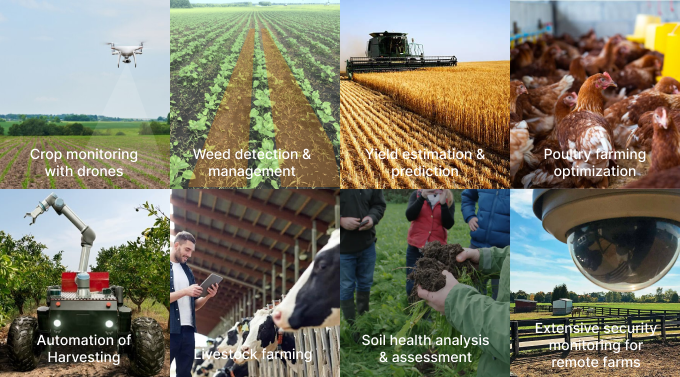
The agricultural sector is undergoing a significant transformation driven by advancements in technology, particularly in the field of computer vision. As we move through 2024, the adoption of computer vision in agriculture is enabling farmers to enhance productivity, optimize resource use, and ensure sustainability. Here are some of the most impactful applications of computer vision in agriculture:
1. Crop Monitoring and Health Assessment
Application: Computer vision systems, integrated with AI video analytics software, can analyze images captured by drones or satellites to monitor crop health in real-time. These systems use algorithms to detect early signs of disease, pest infestations, and nutrient deficiencies.
Impact:
- Early Detection: Farmers can take corrective actions before the issues become severe, reducing crop loss.
- Resource Optimization: Targeted use of pesticides and fertilizers minimizes environmental impact and reduces costs.
2. Precision Agriculture
Application: Computer vision is integral to precision agriculture, which involves the precise application of inputs like water, fertilizers, and pesticides based on the specific needs of different areas within a field.
Impact:
- Increased Yields: Ensures that crops receive the right amount of inputs at the right time.
- Cost Reduction: Reduces the overall use of resources, lowering operational costs.
- Environmental Sustainability: Minimizes runoff and leaching, protecting local ecosystems.
3. Automated Harvesting
Application: Computer vision enables the development of autonomous harvesting robots that can identify ripe fruits and vegetables and pick them without human intervention.
Impact:
- Labor Shortage Mitigation: Addresses the issue of labor shortages in agriculture.
- Consistent Quality: Ensures that only ripe produce is harvested, maintaining quality.
- Operational Efficiency: Harvesting can be done faster and more efficiently.
4. Soil and Plant Analysis
Application: Using computer vision, farmers can analyze soil composition and plant characteristics to make informed decisions about planting, irrigation, and fertilization.
Impact:
- Improved Soil Health: Regular monitoring helps maintain soil fertility and structure.
- Optimized Planting: Ensures that the right crops are planted in the right soil conditions, enhancing growth and yield.
5. Livestock Monitoring
Application: Computer vision systems can monitor livestock behavior and health, detecting signs of illness or distress early.
Impact:
- Enhanced Animal Welfare: Early detection of health issues ensures timely treatment.
- Productivity Gains: Healthy animals are more productive, leading to higher yields in dairy and meat production.
- Cost Savings: Reduces veterinary costs by preventing the spread of diseases.
6. Weed and Pest Management
Application: Computer vision helps in identifying and classifying weeds and pests, enabling precise application of herbicides and pesticides.
Impact:
- Selective Treatment: Only affected areas are treated, reducing chemical use.
- Cost Efficiency: Lowers the cost of weed and pest control.
- Sustainability: Reduces the impact on non-target species and the environment.
7. Yield Prediction
Application: Computer vision algorithms can analyze various factors like plant height, leaf area, and growth patterns to predict crop yield accurately.
Impact:
- Better Planning: Helps farmers make informed decisions about storage, marketing, and resource allocation.
- Risk Management: Provides insights into potential yield variations due to environmental factors, allowing for proactive measures.
8. Sorting and Grading
Application: In post-harvest processes, computer vision systems are used to sort and grade produce based on size, color, and quality.
Impact:
- Quality Assurance: Ensures that only high-quality produce reaches the market.
- Efficiency: Speeds up the sorting process, reducing labor costs.
- Market Value: Helps farmers get better prices for their produce by maintaining consistent quality.
9. Irrigation Management
Application: Computer vision can be integrated with IoT devices to monitor soil moisture levels and plant water needs, enabling precise irrigation.
Impact:
- Water Conservation: Reduces water usage by ensuring irrigation is done only when necessary.
- Energy Savings: Lowers the energy costs associated with pumping water.
- Crop Health: Ensures plants receive optimal water levels, enhancing growth and yield.
10. Climate Resilience
Application: Computer vision helps farmers adapt to changing climate conditions by providing insights into crop performance under different environmental stresses.
Impact:
- Risk Reduction: Helps mitigate the risks associated with extreme weather events.
- Sustainable Practices: Encourages the adoption of farming practices that are resilient to climate change.
- Yield Stability: Ensures consistent yields despite climatic variations.
Conclusion
Looking for ways to build a computer vision application in smart farming and agriculture? Our integrated platform offers exceptional end-to-end tools and machine learning model frameworks to develop, deploy, and scale deep learning vision solutions. To gain complete control over their operations, farmers should adopt AI-driven solutions for real-time produce monitoring and problem-solving. As a leading computer vision software development company, Nextbrain delivers world-class applications to support a variety of industries. With proven expertise in advanced technologies, we create best-in-class applications tailored for agriculture.
 Nextbrain Technologies