The age-old saying “Quality over Quantity” isn’t just a phrase—it’s a principle that even the biscuit manufacturing industry strictly adheres to. In today’s competitive market, where consumers and influencers are extremely conscious about what they consume, product quality has become a crucial differentiator. Consumers are more vocal and transparent with their experiences, often influencing the buying behavior of others. This makes stringent quality checks essential, especially before a product leaves the production line.
Biscuits manufactured on automated lines are expected to meet precise size and shape requirements. A small variation in dough consistency, ingredient levels, or oven temperature can result in inconsistent biscuit dimensions. These inconsistencies can affect packaging efficiency and consumer satisfaction. To address this, many leading manufacturers are turning to computer vision in manufacturing to ensure accurate quality control and better operational efficiency.
In this blog, we explore how AI video analytics software is transforming quality inspection in the biscuit manufacturing sector. We’ll take a closer look at how computer vision AI ensures precise and consistent dimension detection, leading to improved product quality and customer satisfaction. By leveraging computer vision for biscuit dimension measurement, manufacturers can automate inspections, reduce human error, and maintain uniformity—ultimately strengthening their brand reputation and enhancing consumer trust.
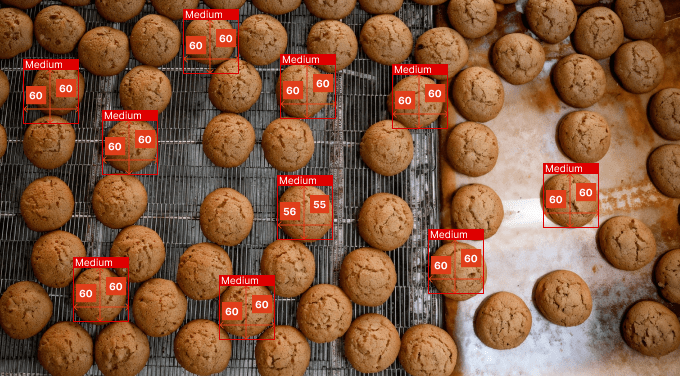
The Role of Consistent Dimension Detection in Biscuit Manufacturing
In the food production sector, maintaining consistency is the key to sustaining customer loyalty. For biscuit manufacturers, dimension detection is a critical part of the quality control process. With growing expectations from consumers for uniformity and precision, manufacturers are increasingly relying on computer vision in food manufacturing to automate and enhance inspection accuracy.
Here’s why consistent biscuit dimensions are essential:
1. Optimized Production Processes
Automated biscuit dimension inspection helps in identifying inconsistencies early in the production cycle. This minimizes downtime, reduces wastage, and enhances overall operational efficiency. By catching defects early, manufacturers can avoid large-scale quality issues, save costs, and ensure a more streamlined workflow.
2. Regulatory Compliance
In many countries, food labeling regulations demand strict compliance with size and weight tolerances. Non-compliance can lead to legal penalties and harm brand reputation. Computer vision in food manufacturing enables real-time regulatory checks, helping businesses meet legal standards effortlessly while maintaining quality.
3. Enhanced Customer Experience
Uniform biscuit size contributes to a visually satisfying and high-quality product presentation. Consistency in shape and size creates a better unboxing and consumption experience for the customer, fostering brand trust and repeat purchases.
4. Efficient Packaging & Protection
Irregular biscuit sizes can lead to inefficient packaging, excess use of materials, and increased chances of breakage. Computer vision in manufacturing ensures that biscuits are of consistent dimensions, which allows for optimized packaging design, secure sealing, and minimal material waste.
How Does Computer Vision-Based Biscuit Dimension Detection Work?
The adoption of AI video analytics software in biscuit manufacturing involves advanced image processing and deep learning algorithms. These technologies enable manufacturers to perform inspections with high accuracy and speed. Here’s a breakdown of how the system works:
Expert Image Acquisition
High-resolution cameras are strategically placed along the production line to capture real-time images of biscuits from various angles. This multi-angle setup ensures a comprehensive visual analysis, adaptable to various line speeds and configurations.
Image Preprocessing
The captured images go through preprocessing to enhance clarity and isolate individual biscuits. The computer vision AI algorithms deal with variations in lighting, complex shapes, and background noise to ensure precise measurements.
Precise Dimensional Feature Extraction
Using vision AI algorithms, the system extracts critical dimensional data such as length, width, and height. These systems can be trained to recognize different biscuit shapes and sizes, allowing manufacturers to inspect a wide variety of products without reprogramming the system from scratch.
Intelligent Comparison with Predefined Standards
The extracted dimensions are automatically compared against predefined quality control standards. This enables flexible inspection across multiple biscuit types, helping companies maintain consistency, adapt quickly to changes, and meet quality requirements across different product lines.
Real-Time Automated Rejection
The system is designed to reject biscuits that fall outside the acceptable dimensional range. This process is entirely automated, eliminating human error and ensuring that only compliant products proceed to packaging. The AI video analytics software triggers a rejection mechanism the moment a defective product is detected.
Surface Defect Detection
Apart from measuring dimensions, AI video analytics software can also be trained to identify visual defects such as cracks, burns, or uneven surfaces. Upon identifying a defect, the system can alert operators or automatically remove the defective biscuit from the production line, providing real-time feedback for process adjustments.
Key Benefits of Computer Vision for Biscuit Dimension Measurement
Implementing computer vision in defect detection offers several benefits that go beyond just inspection. It’s a transformative approach that ensures better decision-making, optimized operations, and superior product quality.
Real-Time Monitoring
Real-time data analysis allows manufacturers to identify and correct production issues instantly. This proactive approach prevents quality problems from escalating and reduces the chances of defective products reaching the market.
Improved Throughput
Automated inspection using computer vision in manufacturing significantly increases inspection speed, enabling manufacturers to handle high volumes without compromising on accuracy. This results in faster time to market and greater production efficiency.
Higher Accuracy and Precision
Computer vision systems offer unparalleled accuracy in measuring product dimensions, eliminating human error and variability. This ensures that every biscuit meets exact specifications, reducing product waste and increasing customer satisfaction.
Scalability and Flexibility
These systems are scalable and easily adaptable to different product types, production line configurations, and inspection requirements. Whether you’re producing round cookies or square biscuits, the AI can be trained accordingly to detect specific features and defects.
Final Thoughts
In today’s competitive market, where consumers expect perfection, the implementation of computer vision AI in biscuit manufacturing is not just a trend—it’s a necessity. By ensuring consistent dimensions, reducing waste, and maintaining regulatory compliance, manufacturers can significantly enhance product quality and operational efficiency.
At Nextbrain, we specialize in delivering cutting-edge solutions for computer vision in defect detection, enabling food manufacturers to streamline their processes and strengthen their brand reputation. Our AI video analytics software is designed to deliver real-time quality assurance, ensuring every biscuit that hits the shelf meets the highest standards.
Want to learn more about how biscuit dimension detection using AI can elevate your manufacturing process? Connect with us today and explore how our computer vision solutions can help your business thrive.
 Nextbrain Technologies