Crop health is the cornerstone of sustainable agriculture. With growing food demands around the world and climate variations, farmers have their work cut out to manage healthy crops. One of the most essential aspects of contemporary farming is the ability to detect plant diseases early on. Once a disease sets in, the losses in yield and quality can be disastrous; in many cases, crops may not even be salvageable.
In this time of smart agriculture, computer vision is revolutionizing foods systems; this subset of Artificial Intelligence (AI) enables automated and accurate disease detection. Thus, computer vision is changing the way farmers scout and monitor crops.
The Importance of Early Detection in Agriculture
Many plant diseases are not evident early on. By the time a diseased plant exhibits visible symptoms that signal the existence of a disease, some damage may already have occurred. Traditional detection approaches – directed by human expertise (or inexperience) – require time, skill, and have the potential for discovery error.
The Food and Agriculture Organization (FAO) of the United Nations estimates that a significant 20-40% of global crop production experiences loss from pests and diseases annually. Plant diseases accounted for more than $220 billion in losses per year. If any data half reflects reality, detection is critical to the agricultural economy and food security.
Common Issues with Disease Detection
- Unseen Infections: Many diseases begin internally and do not exhibit visible symptoms until after they are at the point of no return.
- Limited Expertise: Remote farmers may be unable to access trained agronomists.
- Limited Resources: Farmers who grow regionally or less commonly grown crops, often do not have reference materials to help them identify disease.
- Manual Limitations: It is impossible to inspect large fields manually with consistency.
The Role of Computer Vision in Plant Disease Detection
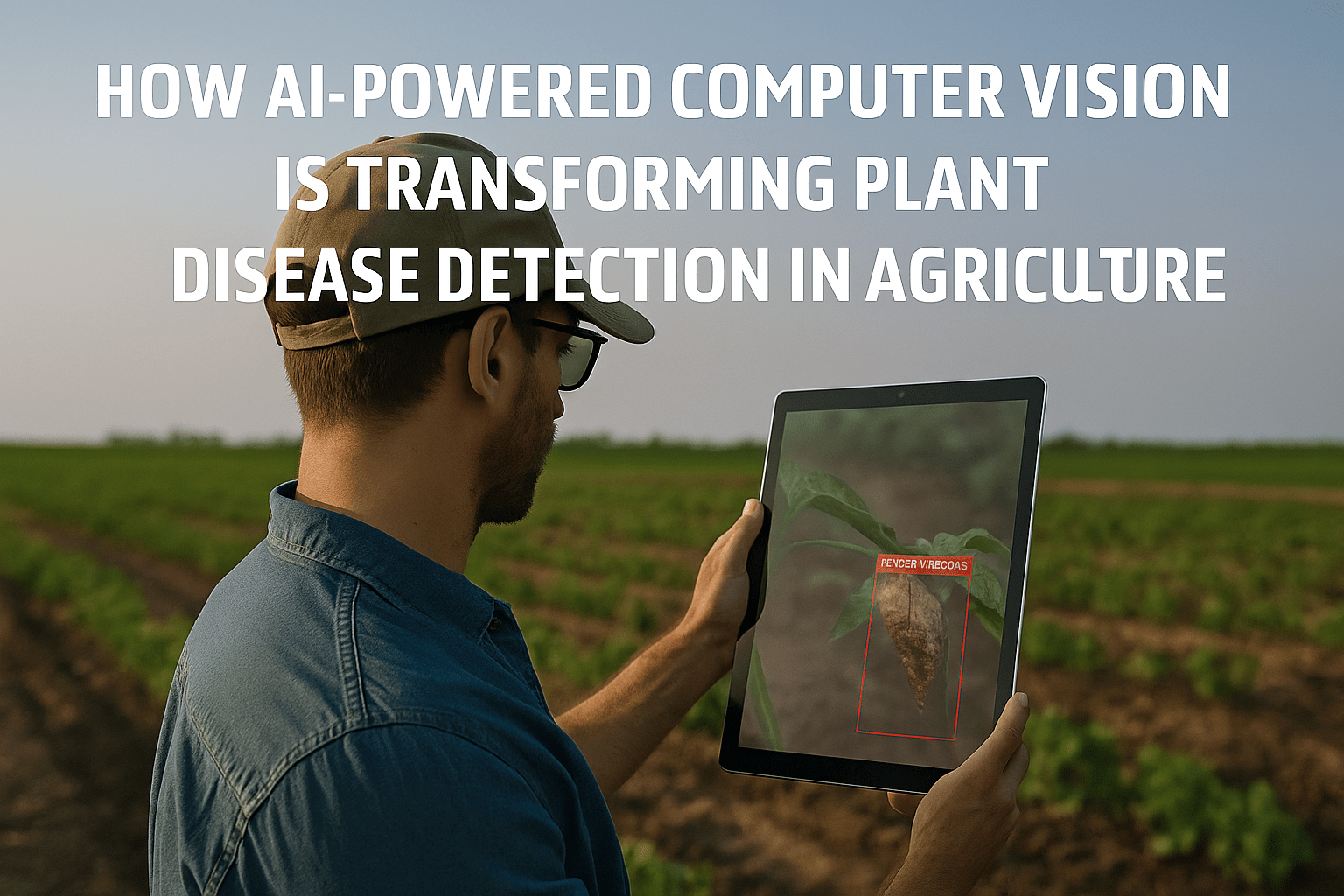
Computer vision for plant disease detection uses image-based analysis to effectively and accurately evaluate plant health. With AI-based systems, farmers can capture high-resolution images of their crops electronically and analyze them in real time using intelligent automation.
What Computer Vision has to offer
- Image Capture via Smart Devices: Ability to cover extensive fields with smart devices like drones, smartphones, or fixed cameras to capture visual data.
- Disease Symptoms: Deep learning systems can evaluate images for disease symptoms such as spots, changes to the texture of the leaves and leaf color changes. These can typically be detected by the system before a human can actually see it.
- Fast & Accurate: Processing images ensures that results are delivered as soon as they are ready so that treatment options can be implemented timely.
- Reduced Human Intervention: The entire disease detection process is automated which reduces labour, human error in identifying disease, and coverage of crop plants.
- Sustainability: Identifying disease at its earliest stage can lead to a reduction in the amount of chemicals used, and increase sustainably-based practices for farming.
- Scalability & Scientific: Artificial intelligence can process thousands of images at once (including multispectral information), with high accuracy rates and a distinction between false positives and costs of treatment.
How the Computer Vision Process Works
When applying computer vision in agriculture, there are several steps to follow:
- Image Acquisition: Farmers fly drones, use smartphones, or communicate with IoT-connected cameras to obtain the first images of their crops.
- Preprocessing: The next step takes the captured images and removes unnecessary or irrelevant information, including performing segmentation and suppression of noise to help improve the accuracy of the analysis.
- Feature Extraction: To classify the diseases in plants, the extracted images will then be processed through a series of deep learning models, particularly a Convolutional Neural Network (CNN) to extract visual features such as lesions, spots (which includes leaf, fruit, and root spots), and changes in texture.
- Disease Classification: The trained algorithm has transformative learnt abilities, naturally comparing the detected features with historical data and in-depth knowlegde of diseases to detect and classify plant related diseases of concern in agriculture such as: blight, rust, brown and grey mould, phytophthora diseases, black leg and more.
- Continuous Learning & Monitoring: In a test of real-time feedback and continued learnings, these systems use alternative learning heuristics to improve based on changing climate conditions, varying crops and evolving diseases.
Vision AI applications in agriculture
There are an array of real-world examples where computer vision is already being applied in agricultural circumstances:
For vineyards, drones have been shown to limit spread of downy mildew and black rot; therefore limiting expensive damage.
For tomato farms, a vision based system was designed and operated by a CEO of a farm that used the ‘Query’ of leaf mould and bacterial spots worn as symptoms to fully produce their crop with the knowledge that danger is present and determine worthwhile treatment options.
These use cases show versatility using AI powered tools to monitor crops independent of crop type and terrain.
Key Considerations for Implementation
Embracing computer vision with plant disease observation in a scalable approach.
1. Environmental Conditions – Light, Weather, and Camera location/duration have effects on image quality. The models must be appropriately trained, depending upon whether there is cloud cover or sun, the angle and resolution of the images taken, and how far apart in time the images take place.
2. Data Quality – Effective model training requires high quality data that are varied (i.e. representing plant growth stage, environmental factors, etc.).
3. System Integration – The AI tools should integrate into existing agriculture management systems, sensors, and their workflow.
Advantages of Computer Vision for Crop Monitoring
- Precision Agriculture: Focused interventions reduce the over-reliance on pesticides and fertilizers.
- Timeliness of treatments: Treating crops quicker isolates affected plants and stops the progression of disease easier.
- Awards: Decreases the need for using large teams for monitoring crops and can minimize delayed losses.
- Scalable: The level of technology work for small farmers and commercial agriculture producers.
Conclusion
Computer vision is reinventing the way we detect crop diseases. It provides new possibilities to monitor crops in the field, rapidly recognize differences in the crops’ conditions, isolated in small areas, and serve the purpose of being applicable to commercial agriculture’s vast footprint.
As agricultural issues become more challenging, embracing such smart technologies for plant disease detection with AI-enabled computer vision is essential. Proactive intervention using AI computer vision-based technologies creates sustainable farming practices which will produce healthier crops and harvests .
FAQs
1. What is computer vision in agriculture?
It is a technology that uses AI and video analytics to monitor crop health by analyzing images of plants. It detects visual symptoms such as discolouration, spots, and leaf damage.
2. Which diseases can it detect?
It can detect a range of issues including fungal infections (rust, blight), pest damage, bacterial spots, nutrient deficiencies, and more.
3. How does computer vision detect diseases?
Using trained AI models, it examines high-resolution images for changes in shape, texture, and colour, identifying diseases early and accurately.
4. What are the benefits of using computer vision?
Key benefits include early diagnosis, reduced labour costs, scalable monitoring, better sustainability, and real-time insights.
5. What tools are necessary?
The necessary tools are drones with imaging systems, stationary IoT cameras, and AI software platforms for image evaluation and reporting.
6. Would this technology help to prevent outbreaks?
Yes, farmers can identify early signs of disease, segregate their infected plants, and manage prompt treatment, thus avoiding extensive loss.
 Nextbrain Technologies