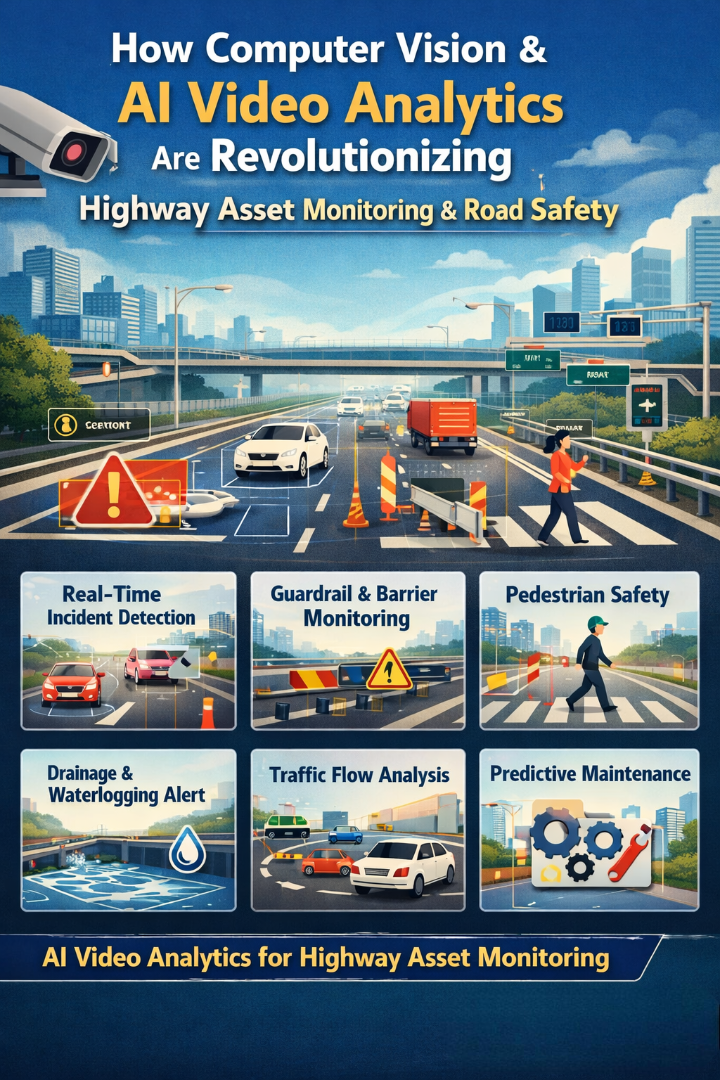
In modern society, transportation plays a crucial role in ensuring seamless road connectivity and sustained economic growth. As urban populations grow and vehicle density increases, the need for safer, smarter, and more resilient road infrastructure has become more critical than ever. Road safety is no longer limited to traffic enforcement—it is a foundational element of smart city development and long-term urban planning. Technologies such as AI Video Analytics for Highway Asset Monitoring are increasingly being adopted to provide real-time visibility, proactive maintenance, and data-driven decision-making across transportation networks.
With rapid advancements in artificial intelligence, computer vision has emerged as a transformative technology across industries including finance, healthcare, manufacturing, automotive, and emergency services. In the transportation sector, computer vision, combined with AI Video Analytics for Highway Asset Monitoring, is redefining how highways and urban roads are monitored, maintained, and optimized. City planners and infrastructure authorities are shifting from manual inspections to automated, continuous monitoring systems that improve road safety, reduce operational costs, and extend infrastructure life cycles.
Traditional highway monitoring methods are often reactive, labor-intensive, and costly due to aging infrastructure, limited inspection resources, and growing traffic volumes. Computer vision addresses these challenges by converting conventional roadways into intelligent, self-monitoring assets capable of real-time assessment and predictive planning.
Applications of Computer Vision Technology in Transportation
Computer vision has become one of the most effective technologies for addressing road safety challenges, traffic congestion, and infrastructure inefficiencies. By integrating AI-powered cameras with advanced analytics, transportation authorities gain actionable insights that were previously unattainable.
Maintaining Road and Highway Safety
Road safety remains a top priority in highway asset management. While traditional Advanced Driver Assistance Systems (ADAS) and intelligent transportation systems focus on vehicle-based sensing, computer vision enhances situational awareness through large-scale visual analytics.
Vision AI systems analyze live video feeds to automatically detect hazards, classify assets, and evaluate their condition in real time. This significantly reduces the risk of accidents, improves roadside safety, and strengthens traffic enforcement by identifying unsafe driving behaviors and infrastructure risks.
Video-Based Analytics and Intelligent Sensing
AI-enabled cameras equipped with video analytics provide a cost-effective alternative to manual inspections. These systems operate continuously, capturing and analyzing visual data without interrupting traffic flow.
Automated video sensing enables authorities to monitor asset health, traffic density, and incident occurrences in real time, helping them make faster and more informed decisions.
Guardrail and Barrier Monitoring
Guardrails and crash barriers play a vital role in minimizing accident severity. However, constant exposure to vehicle impact, corrosion, weather conditions, and structural fatigue often results in unnoticed damage.
Computer vision-based monitoring systems continuously inspect these assets, detecting dents, misalignment, corrosion, or missing components. Early identification ensures timely maintenance, enhancing safety while reducing long-term repair costs.
Real-Time Alerts and Incident Detection
One of the most powerful advantages of computer vision is real-time incident detection. Vision AI can instantly identify stalled vehicles, collisions, unauthorized access, debris, or hazardous conditions on highways.
Unlike traditional surveillance systems that depend on human monitoring, AI-powered systems analyze massive volumes of video data in real time and trigger alerts for traffic authorities and emergency responders. This leads to faster response times and improved incident management.
Enhancing Pedestrian Safety
Pedestrian safety is a critical concern in urban road networks. Computer vision helps reduce pedestrian-related accidents by monitoring crosswalks, intersections, and sidewalks.
AI-powered cameras detect pedestrian movement and interact with smart traffic signals to dynamically adjust signal timings. During peak hours, the system can extend crossing durations, alert drivers, and ensure safer pedestrian mobility, supporting inclusive and people-centric urban planning.
Drainage and Waterlogging Detection
Effective drainage systems are essential for highway safety. Waterlogging and blocked drains can reduce visibility, damage pavements, and increase accident risks.
Computer vision AI models detect water accumulation, blocked drainage paths, and surface deterioration in real time. Continuous monitoring enables authorities to address drainage issues proactively, preventing long-term infrastructure damage.
Improving Highway Infrastructure Efficiency
Computer vision significantly enhances highway infrastructure efficiency by enabling automated inspections, early defect detection, and predictive maintenance planning.
Real-time traffic and asset data empower authorities to reduce congestion, optimize response times, and minimize disruptions—resulting in a more resilient and efficient transportation ecosystem.
Predictive Maintenance and Smart Planning
By analyzing historical and real-time visual data, computer vision systems can identify patterns of wear and degradation. This allows maintenance teams to shift from reactive repairs to predictive maintenance strategies.
Predictive maintenance reduces costs, extends asset lifespan, and prevents unexpected failures that could lead to accidents or traffic disruptions.
Traffic Flow Monitoring and Optimization
Traditional traffic sensors and induction loops often lack accuracy and require frequent maintenance. Computer vision provides a more reliable and scalable alternative.
Vision AI systems analyze video streams to measure traffic volume, speed, congestion patterns, and peak usage hours—helping authorities optimize traffic flow and improve commuter experiences.
Why Choose Nextbrain’s Computer Vision–Powered Highway Asset Monitoring?
Nextbrain’s highway asset monitoring solutions leverage advanced computer vision and deep learning algorithms to analyze video feeds in real time. Powered by intelligent ai video analytics software, the platform automatically detects defects, anomalies, and safety hazards without manual intervention, enabling faster action and preventing costly infrastructure failures.
Unlike traditional inspection methods, Nextbrain’s solutions continuously process visual data from AI-enabled cameras, drones, and existing surveillance infrastructure. This allows early identification of wear, damage, and missing assets, supporting predictive and preventive maintenance rather than emergency repairs.
Designed for scalability, Nextbrain’s platform integrates seamlessly with existing cameras and asset management systems, making it ideal for large highway networks, city roads, and national infrastructure projects.
Final Thoughts
Computer vision is transforming transportation by redefining how road infrastructure is monitored, maintained, and optimized. Through continuous, accurate, and automated inspection, it eliminates the limitations of manual surveys and reactive maintenance approaches.
When combined with AI video analytics, computer vision enables safer roads, reduced accidents, optimized traffic flow, and truly smart urban infrastructure.
Ready to modernize your highway safety strategy? Contact Nextbrain today to discover how computer vision can elevate your road infrastructure.
Frequently Asked Questions (FAQs)
1. What is computer vision in highway asset management?
Computer vision uses AI algorithms to analyze images and videos from cameras, vehicles, and drones to automatically detect, monitor, and assess highway assets.
2. Which highway assets can be monitored using computer vision?
It can monitor road signs, pavements, guardrails, crash barriers, traffic lights, lane markings, lighting poles, and drainage systems.
3. How does computer vision improve road safety?
It identifies damaged or missing assets early, allowing authorities to fix safety risks before accidents occur.
4. Does computer vision support predictive maintenance?
Yes. By identifying early signs of degradation, it enables predictive maintenance, reducing costs and preventing unexpected failures.
5. Is computer vision scalable for large highway networks?
Absolutely. Vision AI systems are highly scalable and suitable for city roads as well as national highway networks.
 Nextbrain Technologies