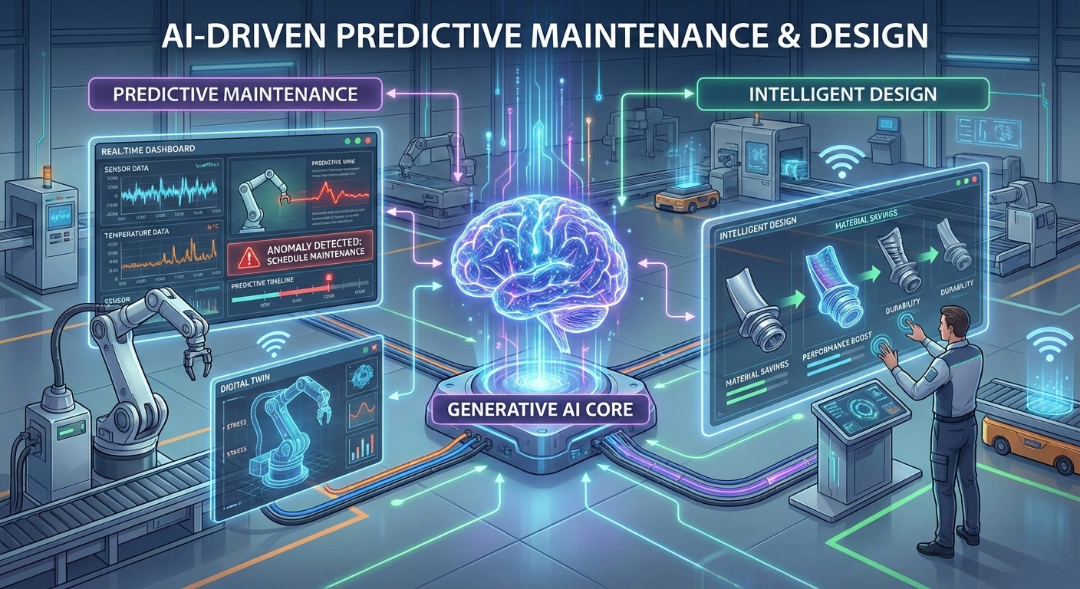
Industries across manufacturing, automotive, energy, and infrastructure are under constant pressure to reduce downtime, optimize performance, and innovate faster. Traditional maintenance and design approaches often reactive and data-siloed are no longer sufficient. This is where a Generative AI development company plays a transformative role by enabling predictive maintenance and intelligent design through advanced AI models.
By leveraging generative AI, businesses can anticipate failures before they occur and design smarter, more efficient systems with unprecedented accuracy.
Understanding Predictive Maintenance in the AI Era
Predictive maintenance focuses on forecasting equipment failures before they happen by analyzing historical and real-time data. Unlike reactive or preventive maintenance, predictive maintenance minimizes unplanned downtime, extends asset life, and reduces operational costs.
A Generative AI development company enhances predictive maintenance by going beyond traditional analytics. Instead of simply identifying patterns, generative AI models can simulate failure scenarios, generate insights from incomplete data, and adapt continuously as new data flows in.
Role of Generative AI in Predictive Maintenance
1. Advanced Data Modeling and Pattern Recognition
Industrial systems generate massive volumes of sensor data temperature, vibration, pressure, and operational logs. Generative AI models can ingest and understand complex, multi-dimensional datasets to detect subtle anomalies that rule-based systems often miss.
A Generative AI development company builds models that learn normal operating behavior and identify early indicators of failure long before thresholds are crossed.
2. Failure Prediction Through Simulation
One of the most powerful aspects of generative AI is its ability to simulate “what-if” scenarios. AI models can generate synthetic failure data to predict how equipment behaves under stress, wear, or abnormal conditions.
This allows organizations to:
- Predict component failure timelines
- Optimize maintenance schedules
- Reduce unnecessary inspections
3. Continuous Learning and Adaptation
Traditional predictive systems often degrade over time as equipment conditions change. Generative AI models continuously retrain themselves using fresh data, making predictions more accurate as systems evolve.
A skilled Generative AI development company ensures these models remain adaptive, scalable, and aligned with real-world operating conditions.
Transforming Product and System Design with Generative AI
Beyond maintenance, generative AI is redefining how products and systems are designed.
1. AI-Driven Design Optimization
Generative AI can automatically generate thousands of design alternatives based on constraints such as material strength, cost, weight, and performance. Engineers can then evaluate the best-performing designs rather than starting from scratch.
This approach significantly reduces design cycles and improves innovation speed.
2. Digital Twins and Virtual Prototyping
A Generative AI development company can create AI-powered digital twins—virtual replicas of physical assets. These twins simulate real-world conditions and predict how designs will perform before manufacturing begins.
Benefits include:
- Lower prototyping costs
- Faster design validation
- Improved reliability and safety
3. Design for Maintainability
Generative AI doesn’t just design for performance—it designs for longevity. By analyzing maintenance data, AI models can suggest design improvements that make components easier to repair, replace, or upgrade.
This creates a powerful feedback loop between maintenance insights and future design enhancements.
Industry Use Cases of Generative AI in Maintenance and Design
- Manufacturing: Predicting machine wear, optimizing factory layouts, and designing energy-efficient equipment
- Automotive: Enhancing component durability, reducing recalls, and accelerating EV design
- Energy & Utilities: Forecasting turbine failures and optimizing grid infrastructure
- Aerospace: Improving safety-critical component design and reducing maintenance costs
In all these sectors, partnering with a Generative AI development company ensures that AI solutions are customized, secure, and production-ready.
Data Integration and System Scalability
Predictive maintenance and AI-driven design rely on seamless data integration across IoT devices, ERP systems, and cloud platforms. A Generative AI development company plays a critical role in:
- Integrating diverse data sources
- Ensuring real-time data pipelines
- Scaling AI models across multiple assets or facilities
- Maintaining data security and compliance
Without expert implementation, even the most advanced AI models fail to deliver value.
Why Choose Nextbrain as Your Generative AI Development Partner?
Nextbrain is a trusted Generative AI development company specializing in predictive maintenance and intelligent design solutions for modern enterprises. With deep expertise in AI model development, data engineering, and industrial use cases, Nextbrain helps businesses move from reactive operations to proactive intelligence.
Nextbrain’s AI solutions are designed to:
- Reduce unplanned downtime
- Improve asset reliability
- Accelerate innovation through AI-driven design
- Deliver scalable and secure AI deployments
By combining technical excellence with industry understanding, Nextbrain ensures measurable business impact from generative AI initiatives.
Conclusion: Build Smarter, More Reliable Systems with Generative AI
Predictive maintenance and intelligent design are no longer optional they are strategic necessities. A capable Generative AI development company empowers organizations to anticipate failures, optimize performance, and innovate with confidence.
If you’re ready to unlock the full potential of generative AI for maintenance and design optimization, contact Nextbrain today and take the next step toward intelligent, future-ready operations.
Frequently Asked Questions (FAQs)
1. How does generative AI improve predictive maintenance?
Generative AI analyzes complex data patterns, simulates failure scenarios, and continuously learns from new data to predict issues before they cause downtime.
2. Is generative AI better than traditional predictive analytics?
Yes. Generative AI goes beyond pattern recognition by generating insights, simulations, and design recommendations that traditional models cannot.
3. Can generative AI help reduce maintenance costs?
Absolutely. By preventing unexpected failures and optimizing maintenance schedules, generative AI significantly lowers operational and repair costs.
4. Which industries benefit most from generative AI–driven maintenance?
Manufacturing, automotive, energy, aerospace, and infrastructure industries see the highest impact.
5. Why choose Nextbrain for generative AI development?
Nextbrain delivers tailored, scalable, and industry-focused generative AI solutions that drive real operational and design improvements.
 Nextbrain Technologies