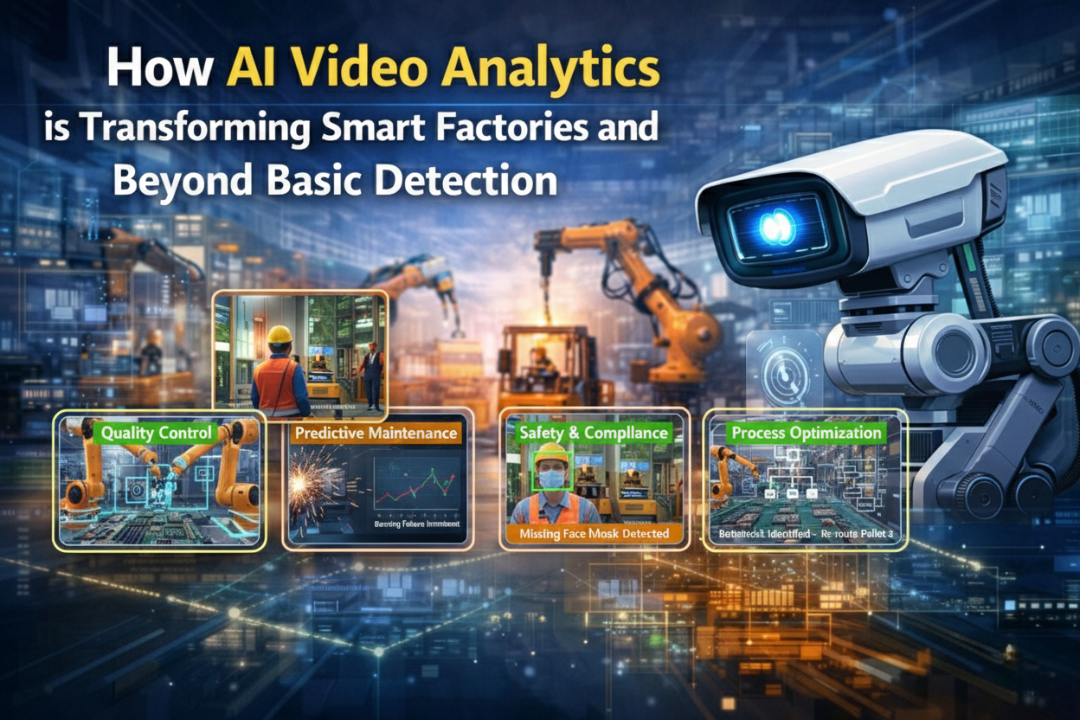
The manufacturing industry is entering a new era where automation is no longer the final goal. Modern factories now focus on intelligence, visibility, and predictive decision making. This shift defines Industry 4.0, where machines, people, and systems operate through continuous data exchange.
Yet one major gap has always existed in automation environments. Machines can produce and measure data, but they cannot understand visual activity on the factory floor. Safety violations, human errors, and process deviations often remain unnoticed until losses occur.
This is where AI Video analytics in manufacturing industry is becoming essential. By converting standard surveillance cameras into intelligent monitoring systems, manufacturers gain real time awareness of operations, behavior, and risks without manual supervision.
AI powered video analytics allows factories to detect problems instantly instead of investigating them after downtime, defects, or accidents occur.
The Need for Visual Intelligence in Industry 4.0
Smart factories rely heavily on IoT sensors, robotics, and machine connectivity. However, many critical events cannot be captured by sensors alone. Human actions, unsafe movement, incorrect handling, and workflow inefficiencies require visual understanding.
Traditional CCTV systems only record footage for later review. They do not interpret events or prevent incidents.
AI video analytics fills this gap by analyzing live video streams continuously and identifying abnormalities as they happen. It effectively becomes a digital safety supervisor and operational analyst working 24 hours a day.
What is AI Video Analytics in Manufacturing?
AI video analytics uses computer vision and deep learning algorithms to interpret video feeds from factory cameras. The system recognizes objects, actions, patterns, and anomalies in real time.
It can detect:
• Unsafe worker behavior
• Missing safety equipment
• Production defects
• Unauthorized access
• Equipment anomalies
• Fire and smoke hazards
The system sends alerts instantly so teams can respond before the issue escalates.
Key Ways AI Video Analytics is Transforming Smart Factories
1. Automated Safety Monitoring
Industrial environments contain moving equipment, heavy machinery, and hazardous zones. Manual supervision cannot cover every location continuously.
AI monitoring automatically detects:
• Workers without helmets or gloves
• Entry into restricted zones
• Unsafe proximity to machines
• Slips, falls, or collapse incidents
This prevents accidents rather than documenting them later.
2. Intelligent Quality Inspection
Human inspectors struggle to identify micro defects during high speed production. Fatigue and repetitive tasks reduce accuracy over time.
AI visual inspection systems continuously examine products and identify:
• Surface defects
• Assembly errors
• Missing components
• Label mismatches
This improves product consistency and reduces recall risk.
3. Production Efficiency Optimization
Manufacturers often face hidden inefficiencies such as idle time and workflow imbalance. AI detects operational bottlenecks by analyzing movement patterns and activity duration.
Managers receive actionable insights to improve layout design, task allocation, and throughput.
4. Predictive Maintenance Support
Unexpected machine downtime leads to major losses. AI systems monitor behavioral patterns of equipment such as irregular motion, abnormal heat indicators, or operational deviation.
Early alerts allow maintenance teams to act before breakdown occurs.
5. Workforce Productivity Analytics
Factories can evaluate how tasks are performed without intrusive monitoring. AI analyzes workflow patterns and identifies improvement opportunities that increase efficiency while maintaining worker comfort.
6. Security and Access Control
Industrial facilities store valuable assets and sensitive materials. AI monitoring detects unauthorized movement, unusual activity, or after hours presence and triggers instant alerts.
Business Benefits for Manufacturers
Continuous Monitoring
AI works without fatigue and covers multiple areas simultaneously.
Faster Decision Making
Managers receive real time alerts instead of delayed incident reports.
Lower Operational Costs
Reduced accidents, downtime, and waste improve profitability.
Improved Compliance
Automated monitoring ensures adherence to safety standards.
Scalable Growth
Factories can expand operations without increasing supervision costs.
The Role of Nextbrain in Smart Manufacturing
Nextbrain is an ai development company delivering specialized computer vision solutions for industrial environments.
Their AI video analytics platforms enable:
• Real time safety monitoring
• PPE compliance detection
• Automated quality inspection
• Worker activity analysis
• Production line monitoring
• Machine interaction alerts
• Fire and smoke detection
The solutions integrate with existing camera infrastructure, allowing manufacturers to adopt smart monitoring without major hardware changes.
By aligning AI models with factory workflows, Nextbrain supports the transition toward data driven manufacturing operations.
The Future of Industry 4.0 with Visual AI
The next stage of smart factories will combine monitoring with autonomous response.
Future AI systems will:
• Pause machines when workers enter hazardous zones
• Adjust production speed automatically
• Predict fatigue related risks
• Coordinate robotic operations with human activity
• Continuously optimize workflow patterns
Factories will move from automated operations to self aware environments capable of preventing operational failures.
Conclusion
AI video analytics is becoming the perception layer of Industry 4.0. It provides real time awareness of safety, quality, and productivity across manufacturing facilities.
Organizations implementing this technology gain improved operational control, safer workplaces, and higher production reliability.
Adopting intelligent monitoring is no longer optional for manufacturers aiming to remain competitive in modern industry.
Contact Nextbrain today to start your smart factory transformation with AI powered video analytics solutions.
FAQs
1. Can AI video analytics work with existing cameras?
Yes. Most solutions integrate with current surveillance infrastructure.
2. Does the system replace human supervisors?
No. It enhances supervision by providing continuous monitoring and alerts.
3. Is it suitable for small manufacturing units?
Yes. Deployment can scale based on facility size and requirements.
4. How quickly does it deliver results?
Many manufacturers observe measurable improvements within a few months.
5. Which industries benefit the most?
Automotive, electronics, pharmaceuticals, food processing, logistics, and heavy manufacturing see strong impact.
 Nextbrain Technologies